The Idea: Free Trade of Unused Items in 2026
Ever looked at that stack of board games gathering dust in your closet and thought, “I’d trade this for a Gojo Figurine from Jujutsu Kaisen”?
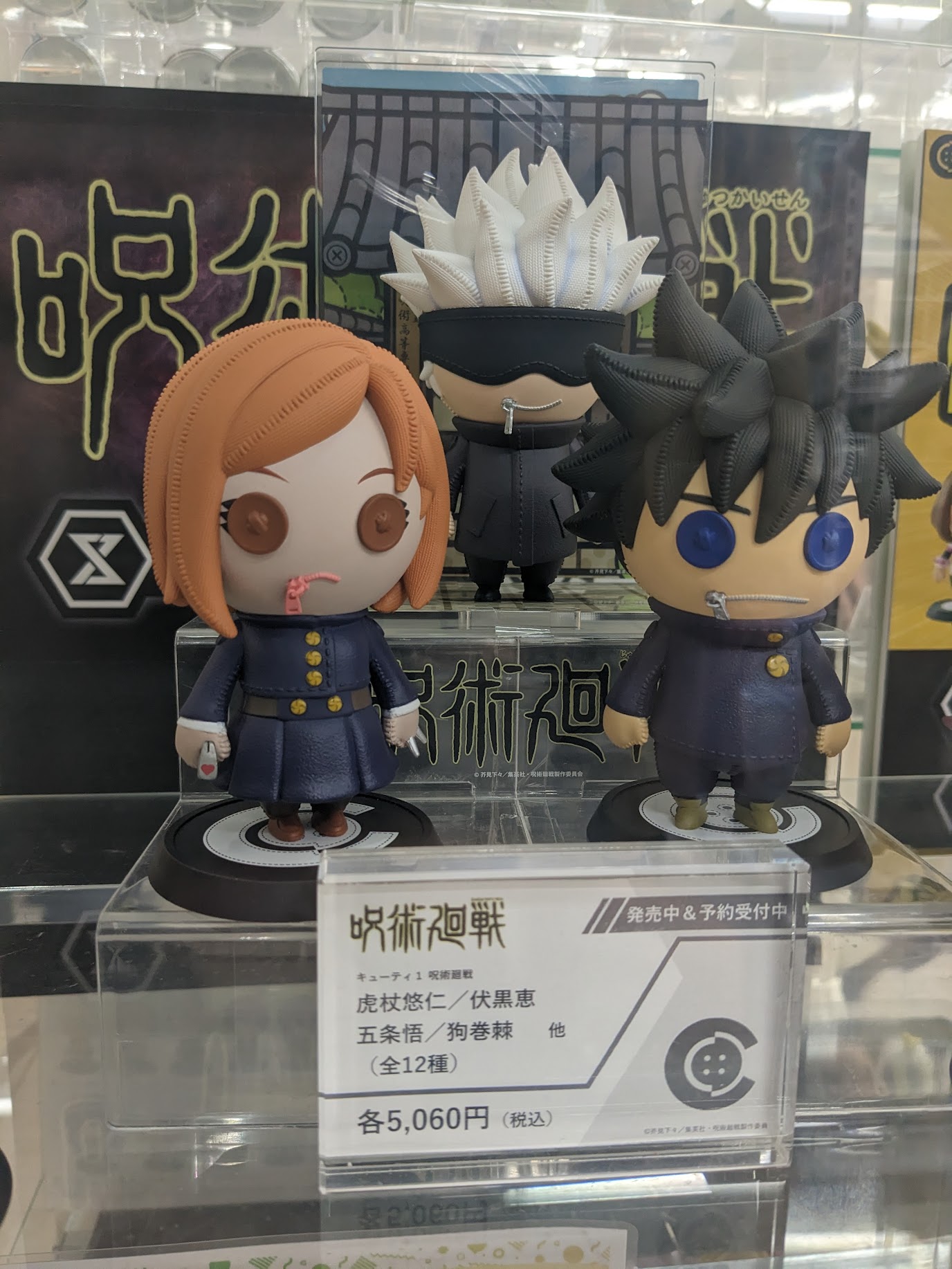
We went down that rabbit hole. Instead of just dreaming about it, we built BulbaSwap a mobile-first attempt at bringing back the long lost barter system. By focusing on high-trust, low-effort exchanges, we’re aiming to turn your “shelf of shame” into a gateway for new hobbies.
Initially focusing on the board game and collectible community.
PS: This is a part of our assignment for FIT5152 which is why it’s called bulbaSwap
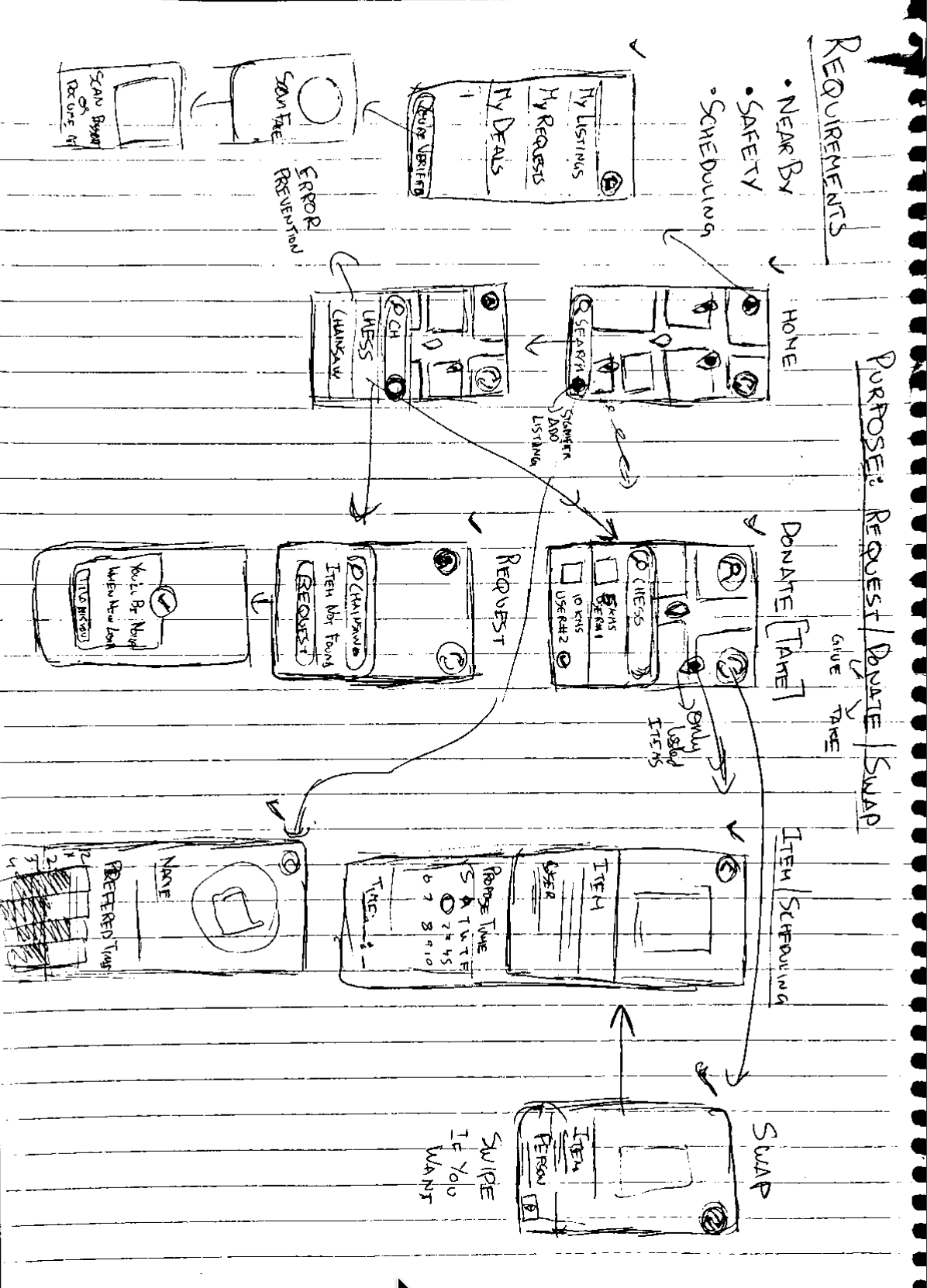
🕵️♂️ Understanding the “Why” (The User Research)
Before we pushed a single pixel in Figma, we had to understand who we were building for. We surveyed 48 participants and found a young, tech-savvy audience (mostly 18-32) that values security above all else.
Key Insights:
- The Mobility Myth: 100% of our respondents are on smartphones weekly, making a mobile-first approach non-negotiable.
- The Trust Gap: 70% of users cited security and privacy as their biggest adoption factor. People are tired of getting “burned” by fake cards or sketchy meetups.
- Logistics Suck: 46% of people are prevented from swapping by the simple pain of the commute.
👤 Meet the “Swappers”
To guide our design, We developed four distinct personas based on our survey data to ensure we were solving real human problems, not just hypothetical ones.
1. Spike Spiegel: The Tech-Savvy Futurist
Spike is a 27-year-old game developer from Sydney who lives on the cutting edge.
- Description: He’s testing games in VR by day and browsing for the next exciting tech gadget by night.
- Goals: He wants to barter rare toys and gaming gear to reduce waste and find discontinued items.
- Pain Points: He hates the lack of previews in current apps. He needs to see the condition of an item before he commits his time.
- Requirements: He relies on his smartwatch for real-time alerts so he never misses a trade update while coding.
2. Riley Williams: The Cautious Explorer
A 26-year-old software developer in Melbourne, Riley is the heart of our “Trust” requirement.
- Description: She’s been scammed before by fake cards on other platforms and approaches trading with a “verify everything” mindset.
- Goals: Building a high-value collection of vintage Pokémon cards and board games.
- Pain Points: Counterfeit items and unreliable traders.
- Requirement: She needs robust verification tools and community-based validation before she’ll even send a “Hello” message.
3. Noah Armstrong: The Budget Gamer
Noah is a 19-year-old IT student in Melbourne who works part-time and manages his ADHD and depression through gaming.
- Description: Gaming isn’t just a hobby; it’s a coping tool to manage his daily moods.
- Goals: Swapping games to keep his collection fresh on a “broke student” budget ($2000/month).
- Pain Points: Complex UI. If a trade takes too many steps, he loses focus and motivation.
- Requirement: He needs a “Fast Swap Workflow”—a clutter-free, intuitive experience that feels frictionless.
4. Sarah Max Stacy: The Casual Collector
Sarah is a 22-year-old Media Studies student in Sydney who represents our “Local” focus.
- Description: Budget-conscious and highly influenced by Instagram and TikTok gaming communities.
- Goals: Finding low-cost swaps and connecting with like-minded people.
- Pain Points: Commute hurdles. She doesn’t own a car and finds long travel a total deal-breaker.
- Requirement: Local discovery and easy scheduling. If it’s not within a short walkable distance or a quick bus ride, it’s not happening.
🎨 Design Philosophy: Principles in Action
Our high-fidelity prototype wasn’t just about looking pretty; it was about using the Rules of Psychology to build trust and efficiency.
1. The Power of Proximity (Gestalt)
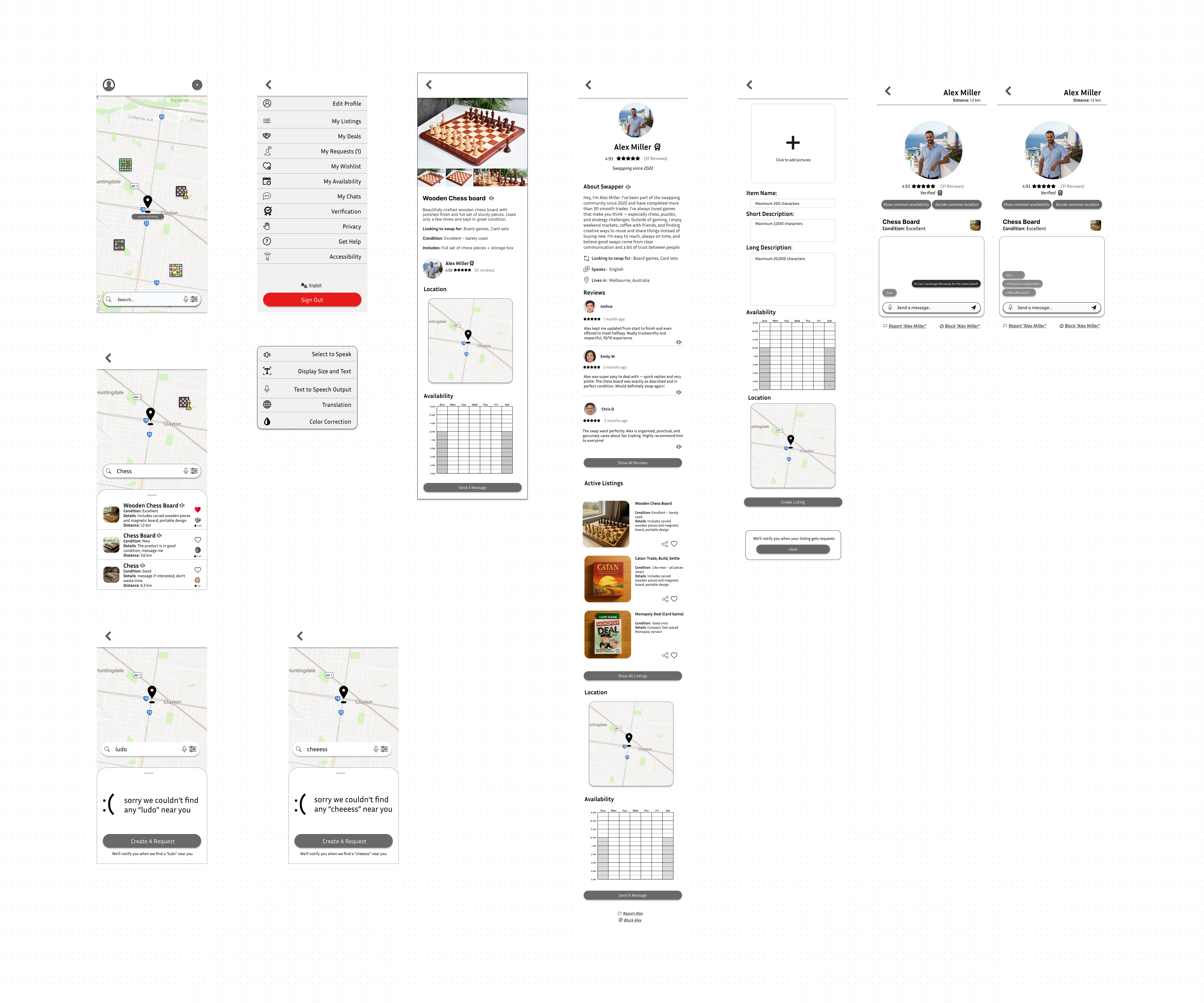
Our Home Screen uses the Gestalt Principle of Proximity. By clustering game icons on a map, users instantly perceive nearby listings as related, making local discovery intuitive.
2. Jakob’s Law in the Chat
We didn’t reinvent the wheel for messaging. Following Jakob’s Law, our chat interface mirrors familiar apps with speech bubbles and a clear text input field. Why? Because users shouldn’t have to learn how to talk to each other.
3. Visual Hierarchy of Trust
On the search results screen, we used a strict visual hierarchy. The item title is bold and prominent, but the swapper’s rating and verified badge are tucked neatly to the right. It gives you the “trust signals” you need without cluttering your scan for the perfect chess board.
♿ Accessibility is Not Optional
We took WCAG 2.1 seriously.
- Perceivable: We avoided using color as the sole indicator of information (WCAG 1.4.1), leaning on a grayscale palette with distinct icons for map pins.
- Operable: We included voice input via a microphone icon in search and chat, supporting users with motor disabilities (WCAG 2.5.6).
- Understandable: A “Color Correction” setting helps users with vision deficiencies adjust display intensity.
🛠 Lessons from the Heuristics
No prototype is perfect. Our team performed a Heuristic Evaluation and found some “catastrophic” areas for improvement—specifically around proactive error prevention.
- The “Undo” Button: We realized we needed a way to edit or undo messages post-send to reduce user anxiety.
- Empty States: Instead of just saying “Sorry, no results,” we recommended adding spelling suggestions and search radius adjustments to keep users from getting stuck.
🚀 The Future of BulbaSwap
Here’s our final Design for BulbaSwap… We’ve laid the groundwork for a trust-based, local barter system, but before we build this out into existance, we want to hear from you.
 Is this a platform you’d use to refresh your collection or declutter your space? Drop a comment below or reach out—let’s shape the future of the modern barter system together.
until next time !️ ✌
or you could spot me in the wild 🤭 i mean instagram, twitter, linkedin and maybe even youtube where i may make video versions of these blog posts